29/09/2026
IDAERO Solutions advances the digital simulation of advanced manufacturing processes in IRIDISCENTE
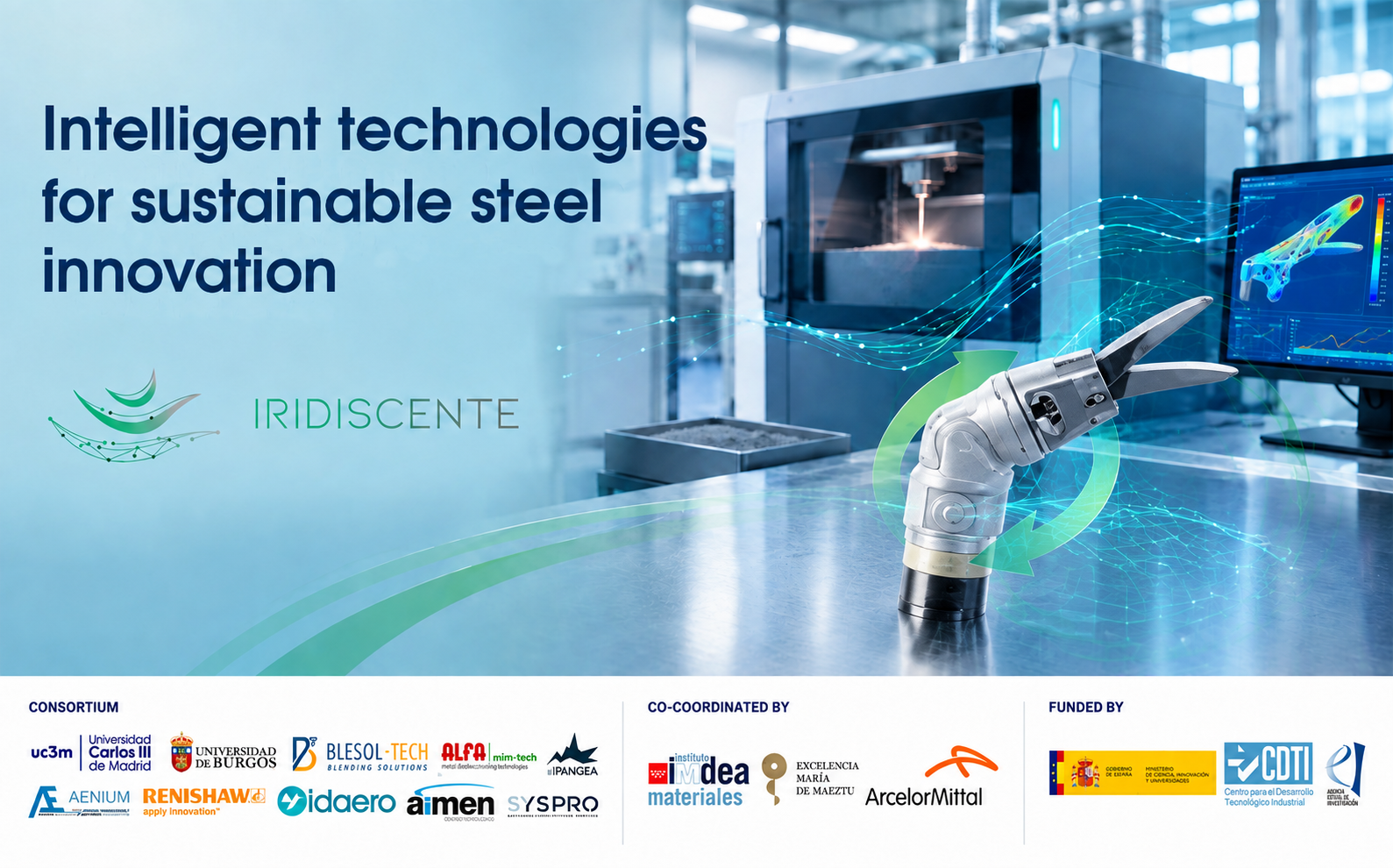
IDAERO Solutions has taken part in the certification meeting corresponding to the yearly reporting period of the IRIDISCENTE project, an industrial research initiative focused on developing safer, more sustainable and more efficient metallic materials.
The project combines the scientific and industrial capabilities required to turn scrap-derived steels into high-performance components for strategic sectors including mechanical engineering, aerospace, automotive and medical applications.
The meeting was held at Renishaw’s facilities in DFactory Barcelona, a leading hub for advanced manufacturing and Industry 4.0. The meeting provided an opportunity to review the progress achieved by the consortium during 2025 and updated to date, share key technical developments and coordinate the project’s next stages.
IRIDISCENTE (Artificial Intelligence for the Sustainable Design of Alloys and Efficient Processes) promotes a digital methodology for designing, processing and characterizing new steel alloys by combining artificial intelligence, simulation and experimental data. Its goal is to connect the information generated throughout the materials value chain in order to accelerate development and improve decision-making.
Progress during 2025
During the 2025 reporting period, the consortium advanced across the project’s four main technical areas: the data environment, machine-learning models, physical simulation and experimental processing and characterization.
A modular end-to-end data architecture was defined to integrate data ingestion, storage, simulation, feasibility assessment and material characterization. In parallel, the main functions of the project’s digital platform were developed, with a modular architecture that supports centralized, on-site and hybrid deployment and enables the ingestion of industrial and file-based data.
The project also made significant progress in sustainable alloy design. A preliminary Safe and Sustainable by Design assessment considered environmental, social, economic, criticality and circularity indicators, characterizing 22 chemical elements and identifying alternative scrap materials with better sustainability performance.
For alloy development, a Tabular Variational Autoencoder was trained using data from 2,198 alloys and 51 variables. The generated compositions were screened using CALPHAD-based criteria and manufacturing constraints, leading to the selection of six candidate compositions: three from the 17-4PH family and three from the M300 family. The selected variants include a 17-4PH proposal incorporating vanadium and nitrogen to promote VN precipitation and an M300 option without cobalt.
Machine-learning models were also developed to support corrosion assessment, powder atomization and automatic material characterization. Preliminary U-Net++ tests for segmenting phases in scanning electron microscopy images achieved prediction accuracy above 80%, while regression models were trained to identify atomisation parameters for controlling powder particle-size fractions.
IDAERO Solutions’ contribution
As a project partner, IDAERO Solutions contributes its expertise in numerical simulation, software development to the digital processes required for the automated and intelligent design, processing and characterisation of metallic materials.
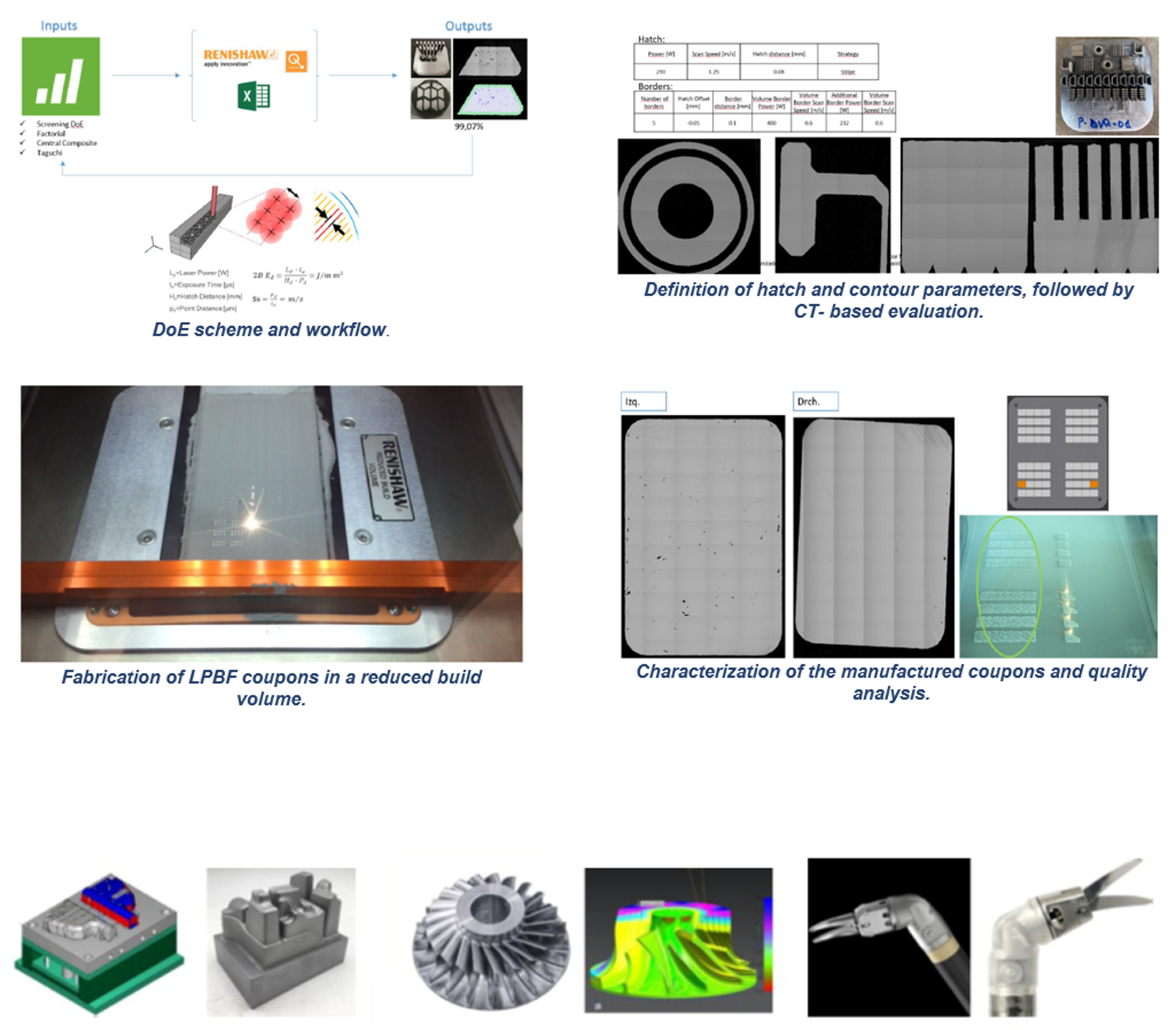
During this reporting period, IDAERO focused on the multiphysics simulation of the four near-net-shape technologies studied in IRIDISCENTE: laser powder bed fusion (L-PBF), laser-directed energy deposition (L-DED), extrusion-based additive manufacturing (CEM) and metal injection moulding (MIM). Work included adapting finite-element models to progressive material deposition, evolving boundary conditions, thermal sources and manufacturing paths extracted from G-Code.
IDAERO implemented an automated simulation pipeline that extracts and adapts material properties, reads manufacturing trajectories and process parameters, generates IRIS solver input files, executes the simulations and organizes the results. Simulation outputs are consolidated in HDF5 files together with geometry, material properties, process parameters and time-dependent results, and an automatic report identifies successful and failed runs.
This workflow has already enabled more than 700 simulations. Consolidating VTU results into HDF5 reduced storage requirements by approximately 70–80%, while the first L-PBF path-simplification developments reduced a test trajectory from more than 70 G-Code movements to three commands without losing the target geometry.
These developments create a structured digital knowledge base that can be used to train reduced-order and machine-learning models and to support the future validation of industrial demonstrators. The consortium has begun preparing this validation through L-DED, L-PBF, MIM and CEM, including the definition of geometries, monitoring data, characterization strategies and sustainability assessment methods.
A collaborative effort
IRIDISCENTE’s progress is made possible by the collaboration of the entire consortium. IDAERO Solutions would like to thank the participating partners for their commitment and contribution: IMDEA Materials Institute, ArcelorMittal, Universidad Carlos III de Madrid, Universidad de Burgos, Blesol Tech, MIM Tech Alfa, The Next Pangea, AENIUM, Renishaw Ibérica, AIMEN and Syspro Automation.
IRIDISCENTE runs from 2024 to 2027 under the TransMisiones 2023 call and is co-coordinated by IMDEA Materials Institute and ArcelorMittal. The project is publicly funded through this call, promoted by the Spanish Ministry of Science, Innovation and Universities, the Spanish State Research Agency and CDTI Innovación.
IRIDISCENTE se desarrolla entre 2024 y 2027 en el marco de la convocatoria TransMisiones 2023 y está coordinado conjuntamente por el Instituto IMDEA Materiales y ArcelorMittal. El proyecto recibe financiación pública a través de esta convocatoria, impulsada por el Ministerio de Ciencia, Innovación y Universidades, la Agencia Estatal de Investigación y CDTI Innovación.
Esta publicación forma parte del proyecto PLEC2023-010190 financiado por MCIN/AEI/10.13039/501100011033.
Expediente: PLEC2023-010190
Acrónimo: IRIDISCENTE
Denominación: Inteligencia Artificial para el Diseño Sostenible de aleaciones y Procesos Eficientes
